
2026 feels like a next step to me – a chance for Outlandish and other tech co-ops to gather business momentum again after a difficult and underwhelming few years.
That is, it’s an opportunity for businesses like ours, if we can give due attention to AI, net zero and the UK government’s new 10 year Modern Industrial Strategy.
1. Net Zero and the Modern Industrial Strategy
Let’s start with the latter. The Modern Industrial Strategy, which launched in 2025, is a fascinating document and is indicative of substantial changes to come: a 10-year plan to increase business investment and “drive innovation”, “capitalise on UK data”, and “enhance skills and access to talent” across eight sectors:
- Advanced Manufacturing
- Clean Energy Industries
- Creative Industries
- Defence
- Digital and Technologies
- Financial Services Growth and Competitiveness Strategy
- Life Sciences
- Professional and Business Services
For businesses and tech co-ops like Outlandish, some of these are more obviously relevant (and palatable) than others. Clean Energy and its drive toward net zero is a standout one for me, and is certainly an area I will be paying attention to in 2026. (FYI the accompanying Clean Energy Sector Plan is also well worth a read).
The Strategy calls the pursuit of clean energy “the economic opportunity of the century”, and points out that “the net zero economy is already growing three times faster than the wider UK economy”.
Of further importance to co-ops like ours:
- Huge numbers of co-ops are already involved in local renewable energy generation and retrofit projects.
- Community Energy England’s State of the Sector Report 2025 counts 614 community energy organisations in the UK – a whopping 21% increase since 2021.
- The Modern Industrial Strategy prioritises cross-cutting themes of local & place-based infrastructure, resilience, shared capabilities, tooling, innovation and “frontier technologies” (AI being of most relevance).
- The strategy is committing to reducing the cost of electricity, as well as passing on the benefits of renewables to consumers.
It’s clear that there is a lot of alignment with the data and place-based specialisms of agencies like Outlandish, plus others in the CoTech movement.
I’m fully aware that the majority of community energy groups don’t have the funds to build data-based tech – and certainly not the “frontier technology” that is a running theme in the Strategy. So I’m not arguing that we will find significant income generating collaborations there.
However the government’s strategy suggests there will be sizable opportunities for tech co-ops to position themselves as the ideal delivery partners for data-based, net zero and place-based/local-infra projects. Think: delivering data-based projects for-and-in-partnership with local authorities, larger community energy organisations and academic institutions; plus tracking funding opportunities through larger bodies like Innovate UK and the UKRI .
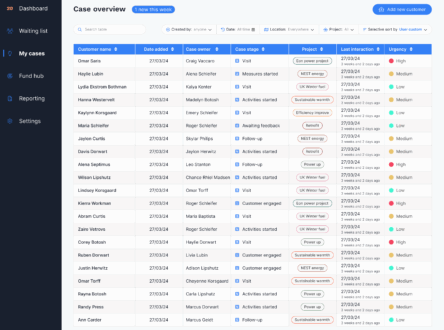
Certainly we’ve seen this start to happen over the last 2 years at Outlandish, with us securing some £200k+ of funding for clean energy projects, including NookCRM, our CRM tooling for the community energy sector. Plus our place-based data product incubation work for Connected Places Catapult.
So, for 2026 I’m considering how we might further establish our delivery partner chops and demonstrate Outlandish’s strong technical and subject matter expertise. At the forefront of my mind are:
- Running clean energy-related events in SPACE4
- Organising clean energy hack days & design studio events, along with masterclasses and roundtables
- Showcasing more data and place-based projects
- Proactively strengthening relationships with academic institutions and our partner councils to gain visibility as potential delivery partners
- Focusing our comms on the above
All this aims to put Outlandish at the heart of data, clean energy and net zero thinking. And other co-ops would be well placed to follow suit.

2. Let’s become experts in AI
Secondly, let’s address the elephant in the room.
Whether or not you think AI is a bubble, and whether or not you believe that AI is extractive, climate-damaging and worse, the reality is that AI is here. People are using AI tools sporadically within their 9-5 and personal lives and (most importantly for our businesses) clients are asking about its potential. As such we need to recognise and face it.
I’ll get to exactly what clients are asking in a second, but first let me be clear that I am NOT arguing we should put our concerns around AI aside. I believe in avoiding extractive data collection, resisting data colonialism, fighting for privacy, upholding copyright protections and more.
What I am saying is: tech co-ops need to upskill now so that we can understand AI properly, use it responsibly where it helps, and push back effectively where it harms.
First step, demonstrating we know what we’re talking about:
For instance, let’s focus first on the unhelpful catch-all term of “AI”. We all use it, but “AI” as a term bundles together some horribly destructive technologies with some incredible, community-benefiting ones. And if co-ops keep on talking about AI as one uniform blob, we won’t be able to distinguish between what’s possible, what’s risky, and what’s worth championing.
So when we as co-ops talk about “AI”, we should be clear and, in doing so, we can demonstrate our expertise. For instance, when we refer to “AI” are we referring to generative AI tools like the ChatGPT, Claude and Gemini? Or do we mean techniques like machine learning, to spot patterns in data (e.g. cancer cells in imagery)?
Are we referring to “AI” as in huge, extractive, environment destroying data-centre driven models? (FYI OpenAI is planning on using 1million+ Nvidia Graphic Processing Units by the end of 2025) Or do we mean “AI” like the https://lauleo.com/ project, which supports and maintains the endangered Māori language? This uses large language models like ChatGPT, BUT it’s based on ~300 hours of voluntarily submitted audio, it runs on just two GPUs and it’s owned by the community it serves. Now that’s AI worth championing.
In short: AI literacy is now part of trust. If we want to be credible delivery partners for clients and larger institutions, we need to understand and demonstrate that we understand the landscape properly.
What clients are asking about AI
So what are our delivery partners asking?
Right now Outlandish’s clients are openly asking us to “horizon scan” and “future-proof” architecture in regard to AI. They don’t want today’s builds to block AI integrations later.
In other words, we’re facing a credibility test: we’re being asked, are you modern/strategic? Or are you just delivering work?
Or as my colleague Natasha succinctly puts it: regardless of our stance, clients are looking to us to have expertise in it. There’s that idea of AI literacy as key to trust building again.
As for specific use cases that clients have suggested (and which, tbh, I can see these having value in projects rather than being mere AI magic-sprinkles), here’s a few examples I’ve heard recently:
- Content websites / advice platforms: AI used to aid internal content discovery. Think of intelligently recommended “you might also like…” content served on articles, without the manual bias of editors (i.e. content admins linking to the same pages again and again).
- Content websites / advice platforms: sentinel monitoring + update prompts. Imagine a scenario where a government’s policy change triggers a flag for website editors to review specific advice pages. Perhaps edits are also suggested for review.
- Campaigning orgs: rapid-response fact-checking. A politician makes a claim, the claim is monitored, counter-sources are automatically cited and a rebuttal is drafted fast enough to hit the same-day news cycle.
There are also internal opportunities to make co-op work more productive and impactful, whilst remaining ethical:
At least one agency in CoTech is using locally-running LLMs to review past-proposals and to help write new ones in responses to client briefs. This sounds interesting, as proposal docs are very laborious to write: every single one needs to be unique, but they also rely on so much personal knowledge (and the technical knowledge of the teams who aren’t writing the proposal). Leveraging a repository of past proposals could offer some real time savings.
Similarly, at Outlandish we’ve discussed using AI tools to surface knowledge from our weighty wiki documentation (273 articles and counting on how-to-Outlandish).
What we can do about AI now, today
Here’s a few AI takeaways that you might want to consider:
- Read / listen to Karen Hao’s excellent book, Empire of AI. As well as being a great introduction to data colonialism, it’s a useful tool for understanding the evolution of AI, the forms of AI, and the politics around it.
- If you’re interested in product design or product management, do a quick course on using AI tools for product design/management. Here’s a 1-hour masterclass you can do right now with the Interaction Design Foundation: Get Ahead in Product Design with AI. The presenter does promote the use of extractive AI tools, however they claim that their approach is tool agnostic – and certainly the underlying principles of using AI to critique product ideas from a range of different design roles is an interesting one.
- If you’re an experienced developer, consider joining the Founders & Coders AI course. The work landscape is changing even more severely for engineers – don’t get left behind: https://programme.foundersandcoders.com/
- Set an AI policy. You’ve probably talked about doing it already, so now’s the time to do it. Here’s an AI policy template for charities (originally created in 2024 by Platypus Digital and William Joseph) that you might want to adopt/adapt.
2026 here we come
So there we are. In 2026, I will be exploring more opportunities to align our technical offering with the Industrial Strategy and “frontier tech” like (good) AI. I think other co-ops should too.
And as we kick off the New Year, initial opportunities seem to be in net zero / clean energy / local infrastructure (e.g. data tooling, and community energy, retrofit & place-based projects), and the use of responsible AI tied to increasing civic capacity.
I believe there are also some business opportunities in the areas of tech sovereignty – tools, infrastructure, independence, shared capability. This also aligns with the Modern Industrial Strategy in its running themes of stability and resilience. Look out for more on this in a further post.
Lead image by Benjamin Chambon on Unsplash
Abstract image by Sebastian Svenson on Unsplash